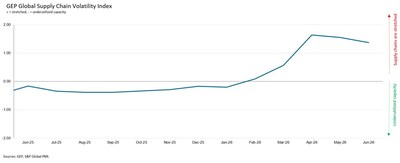
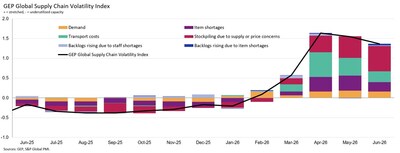
CLARK, N.J., July 13, 2026 /PRNewswire/ -- GEP Global Supply Chain Volatility Index — a leading indicator of supply-chain conditions based on a monthly survey of 27,000 businesses — showed global supply chain pressures remained elevated in June despite falling oil prices and lower transportation costs, reflecting uncertainty surrounding the US-Iran ceasefire.
Reports from manufacturers of backlogs rising due to shortages of critical inputs were their highest since late 2022. The data suggests supply-chain bottlenecks are likely to persist into at least the third quarter as businesses wait for materials needed to complete customer orders.
To guard against further disruption, manufacturers continued building buffer inventories in June. Reports of safety stockpiling increased again and remained at their highest level since January 2023.
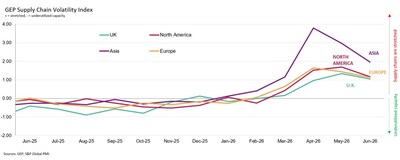
Demand for raw materials, commodities and intermediate goods remained strong across North America and Asia, reinforcing expectations that supply-chain activity will stay elevated in the coming months as inventories are replenished and existing orders are fulfilled. In contrast, input demand weakened across Europe.
"The rise in stockpiling and persistent order backlogs point to one clear conclusion: businesses still don't trust the global trading environment to remain stable," said John Piatek, vice president, consulting, GEP. "Despite lower oil prices and easing transportation costs, companies continue buying ahead because they expect further disruption. While this is encouraging for the global economy in the near term, it also shows manufacturers remain very cautious and are planning for more disruption in international trade."
Interpreting the data:
Index > 0, supply chain capacity is being stretched. The further above 0, the more stretched supply chains are.
Index < 0, supply chain capacity is being underutilized. The further below 0, the more underutilized supply chains are.
JUNE 2026 REGIONAL KEY FINDINGS
JUNE 2026 KEY FINDINGS
For more information, visit www.gep.com/volatility.
Note: Full historical data dating back to January 2005 is available for subscription. Please contact economics@spglobal.com.
The next release of the GEP Global Supply Chain Volatility Index will be 8 a.m. ET, Aug. 12, 2026.
About the GEP Global Supply Chain Volatility Index
The GEP Global Supply Chain Volatility Index is produced by S&P Global and GEP. It is derived from S&P Global's PMI® surveys, sent to companies in over 40 countries, totaling around 27,000 companies. The headline figure is a weighted sum of six sub-indices derived from PMI data, PMI Comments Trackers and PMI Commodity Price & Supply Indicators compiled by S&P Global.
A Supply Chain Volatility Index is also published at a regional level for Europe, Asia, North America and the U.K. For more information about the methodology, click here.
About GEP
GEP® delivers AI-native procurement and supply chain solutions that help global enterprises become more agile and resilient, operate more efficiently and effectively, gain competitive advantage, boost profitability and increase shareholder value. Fresh thinking, innovative products, unrivaled domain expertise, smart, passionate people — this is how GEP SOFTWARE™, GEP STRATEGY™ and GEP MANAGED SERVICES™ together deliver procurement and supply chain solutions of unprecedented scale, power and effectiveness. Our customers are the world's best companies, including more than 1,000 Fortune 500 and Global 2000 industry leaders who rely on GEP to meet ambitious strategic, financial and operational goals. A leader in multiple Gartner Magic Quadrants, GEP's cloud-native software and digital business platforms consistently win awards and recognition from industry analysts, research firms and media outlets, including Gartner, Forrester, IDC, ISG, and Spend Matters. GEP is also regularly ranked a top procurement and supply chain consulting and strategy firm, and a leading managed services provider by ALM, Everest Group, NelsonHall, IDC, ISG and HFS, among others. Headquartered in Clark, New Jersey, GEP has offices and operations centers across Europe, Asia, Africa and the Americas. To learn more, visit www.gep.com.
Media Contacts
Derek Creevey | Joe Hayes | S&P Global Market Intelligence |
Director, Public Relations | Senior Principal Economist | Corporate Communications |
GEP | S&P Global Market Intelligence | Email: Press.mi@spglobal.com |
Phone: +1 646-276-4579 | Phone: +44-1344-328-099 | |
Email: derek.creevey@gep.com | Email: joe.hayes@spglobal.com |

 View original content to download multimedia:https://www.prnewswire.co.uk/news-releases/businesses-continue-building-buffer-stocks-in-anticipation-of-further-disruption-as-supply-shortages-persist-gep-global-supply-chain-volatility-index-302822818.html

Bei der Verleihung des BRICK AWARD 26 in Wien hat ein vietnamesisches Projekt den Ton für die internationale Ziegelarchitektur vorgegeben: Der Đạo Mẫu-Tempel mit angeschlossenem Museum wurde mit dem Grand Prize ausgezeichnet. Das Gebäude, das laut Veranstalter CO2-negativ errichtet wurde, setzt auf lokale Tonziegel und gilt als besonders ressourcenschonend. Die Gala in der österreichischen Hauptstadt zeigte, wie weit das Spektrum zeitgenössischer Keramikarchitektur inzwischen reicht – von religiösen Stätten in Asien bis zu Industrieanlagen in Lateinamerika.
Der BRICK AWARD wird seit 2004 alle zwei Jahre vergeben und versteht sich als herstellerunabhängige Plattform für Architekturbüros, die mit Ziegeln und Keramik arbeiten. Ausrichter ist der Baustoffkonzern Wienerberger, der mit dem Preis ein internationales Netzwerk von Pionieren der Ziegelarchitektur bündelt. Prämiert wird in fünf Kategorien: „Feeling at home“ für Einfamilienhäuser und kleinere Projekte, „Living together“ für städtische Wohnanlagen, „Working together“ für Gewerbe- und Industriebauten, „Sharing public spaces“ für öffentliche Gebäude und Räume sowie „Building outside the box“ für besonders innovative Ansätze.
Auf der Ebene der Einzelkategorien spiegelten die diesjährigen Gewinner zentrale Branchentrends wider. In der Kategorie „Feeling at home“ wurde ein offenes Einfamilienhaus auf Mallorca ausgezeichnet, das mithilfe speziell gesetzter Wände den Meerblick maximiert und zugleich Privatsphäre schafft. „Living together“ entschied ein gemischt genutztes Gebäude in Barcelona für sich, das nachhaltige Ziegel mit einem sozialen Innenhof kombiniert und damit auf dichte, aber gemeinschaftlich orientierte Stadtentwicklung setzt. In „Working together“ ging die Auszeichnung an ein Lager- und Bürogebäude in Mexiko, das lokale Keramik und vulkanisches Material integriert und so industrielle Nutzung und regionale Baustoffe verbindet.
Erstmals vergab die Jury zusätzlich einen Sonderpreis für innovatives gemeinschaftliches Wohnen. Dieser ging an ein Projekt in Belgien, das wiederverwendete Ziegel einsetzt, um eine nachhaltige Nachbarschaft zu schaffen. Der Fokus auf Recycling, CO2-Reduktion und lokale Materialien zieht sich damit durch zentrale Gewinnerprojekte des BRICK AWARD 26. Für Wienerberger, dessen Aktie zum Zeitpunkt der Meldung bei 22,71 Euro notierte, schärft die Auszeichnung zugleich das Profil als global vernetzter Akteur im Bereich Ziegel- und Keramiklösungen – mit dem nächsten Termin im Finanzkalender, der Quartalsmitteilung am 12. August 2026, bereits in Sichtweite.